
Last Friday in clinic, we encountered a patient who is quietly reframing my understanding of what it means to practice medicine across cultures.
He was an elderly man who had been diagnosed at a large city hospital with a 15-centimeter liver mass and was under the care of an oncologist. His medical record noted that treatment was ongoing, and at his most recent checkup, he was told that “everything is going well.” Yet when he arrived at Bangkla Baptist Clinic, his story told something different: persistent abdominal fullness, pain, loss of appetite, and a general feeling of unwellness. His condition was not improving.
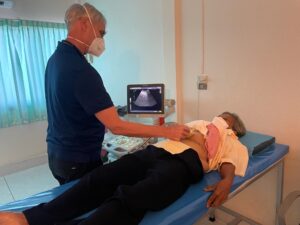
He and his wife had driven two and a half hours to be seen at our clinic. When asked why they had come so far after their recent checkup, his wife answered simply: “We just wanted to know the truth.”
That sentence has stayed with me.
In Thailand, as in many cultures, receiving bad news (particularly a diagnosis of cancer) is handled with great caution. There is a deep cultural aversion to speaking devastating diagnoses directly to patients. In some families, relatives receive the diagnosis and choose not to disclose it to the patient, believing that naming the illness gives it power, or that shielding the patient from distress is an act of love. If the illness is not spoken aloud, perhaps it is not fully real.
This worldview comes from a place of care, protection, and respect for harmony. And yet, it introduces a profound tension for clinicians trained in Western models of medical ethics, where patient autonomy, informed consent, and transparent communication are foundational. When families ask providers not to share concerning findings, or when patients sense something is wrong but are not told, we find ourselves standing in a delicate space between cultures, values, and expectations.
The question becomes:
How do we practice medicine with integrity while honoring cultural humility?
How do we respect family dynamics while also honoring a patient’s right to understand their own body and health?
Is there a middle ground between blunt disclosure and complete silence?
I do not believe this tension has easy or universal answers. But, I am learning that effective cross-cultural care requires deep listening, patience, and a willingness to ask: What does compassion look like in this context? Sometimes, the truth must be spoken gently. Sometimes, it must be uncovered slowly. Sometimes, the role of the clinician is not to force information, but to create a safe space for patients to ask the questions they are ready to ask–just as this couple did.
Their journey to our clinic was not simply for medical consultation. It was a search for clarity amid uncertainty. A desire to be seen, heard, and taken seriously. It was a simple bedside ultrasound to confirm what they already knew–the tumor is not getting smaller. And it reminded me that truth, when offered with humility and love, can itself be a form of healing.
Scripture offers guidance here:
“Speaking the truth in love, we are to grow in every way into Him who is the head, into Christ.” — Ephesians 4:15
Truth without love can wound. Love without truth can mislead. But when held together, they guide us toward integrity, compassion, and personal, professional, and spiritual growth.
As I continue learning in this setting, I am grateful to patients who trust us with their questions, fears, and hopes. They are reminding me that medicine is not only about diagnosing disease, but also about walking with people through uncertainty with honesty, gentleness, and grace.