
My time with the hill-tribe Karen people of Northern Thailand has been one of the most meaningful parts of this service-learning experience. More than any clinical encounter or project, it has shaped how I understand what it truly means to serve with humility.
During our time together, Kitty (my host, interpreter, and guide) shared something with me that I will carry long after I leave. She said she was grateful, not because of anything I had done, but because, in her words, “You are coming not just to do, but to see us, to listen, and to understand our way of life.” She explained that many foreigners come with good intentions but remain distant—hesitant to try traditional foods, reluctant to sit and linger in the community, and uncomfortable participating in daily life. Too often, people arrive to help without truly entering into a relationship. Her words helped name what I have been learning and realize this is where cultural humility matters most.
It is one thing to read about a culture, attend lectures, or study a region’s health statistics. It is another thing entirely to sit on the floor of a home, share meals that stretch your comfort zone (I now know what a pangolin is because I ate one), and listen to stories through translation. These practices allow you to be both a guest and a student, a friend and a learner. Because health, here, (and you could argue everywhere) cannot be separated from life. Belief, tradition, food, family, land, history, and rhythm all shape what it means to be well.
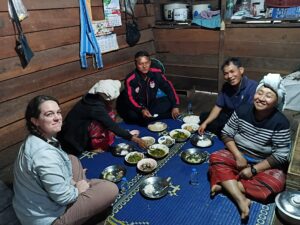
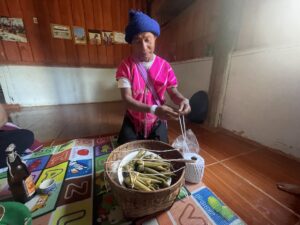
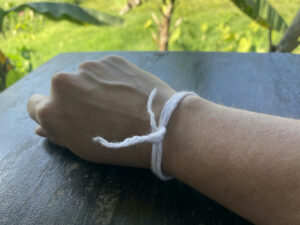
While in the village, I was invited to participate in a Karen hand-tying ceremony — a deeply meaningful tradition of blessing and connection. This ceremony takes place twice a year, just before and just after the harvest, when families who have moved away return home to feast, offer blessings, and spend time together. Strings are gently tied around wrists as words of hope, protection, and belonging are spoken.
That day, the village was filled with color as people wore traditional Karen clothing. We moved from home to home, sharing food and stories. We visited one man whose daughter was not there, and I think it brought him great joy to share the celebration with us, tying our wrists and giving us the traditional Karen blessing.
Kitty’s gratitude and the hospitality we received reminded me of Hagar’s encounter with God in Genesis, when she names Him El Roi — “the God who sees.” God saw Hagar in her suffering, her displacement, and her humanity.
As healthcare providers, we are called to reflect that same seeing.
We cannot truly understand what makes people healthy, or what possibilities exist for improving their wholistic health (physical, emotional, spiritual, and intellectual), unless we first understand how people live, what they believe, and why they make the choices they do. Cultural humility asks us to set aside the posture of the expert and come instead as learners, not to save, not to remake others in our image, but to honor what already exists.
This is why I believe it is called service-learning. I am not here as the authority. I am here with open hands and an open heart — to learn, to listen, and to bear witness to the dignity, resilience, and wisdom of the Karen people.
God sees them.
And if we hope to serve well, we must learn to see them too.