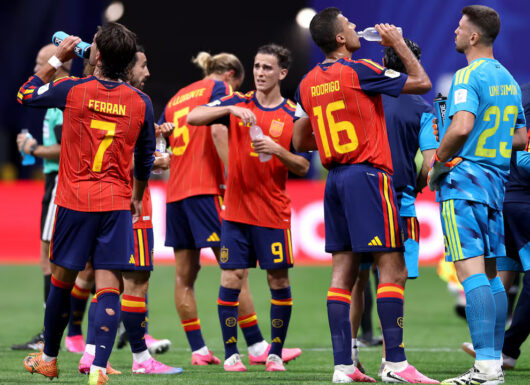
 The FIFA World Cup has a way of pulling people in. We relish watching thousands of fans anticipating dramatic goals, breathtaking saves, and sweet moments of athletic excellence. Our stadiums pulse with energy as supporters wave their national flags, sing their country’s anthems, and cheer alongside people from every corner of the globe. Just off camera, foreigners and new friends meet in restaurants and shops, and strangers rapidly become companions through their shared love of the beautiful game. For a few remarkable weeks, the World Cup reminds us that although we originate from different nations, speak divergent languages, and cherish distinct traditions, the thrill of competition and the joy of celebrating together have thirst quenching power to bring our world closer. We are truly drinking from the world’s cup.
As a preschooler, I watched my father George play soccer at Park University. Dad was an immigrant from Greece, and his talent for the sport landed him on a school team – one where hardly any of the players shared the same first language. Spanish, Arabic, Italian, Greek mattered little as they united in vigorous – yet humane – competition. Dad instructed me that his team’s makeup of divergent individuals was their great strength.
Is today’s worldwide appreciation merely a passing craze, or could it signal a lasting transformation in how we human beings relate toward one another? Will we simply sample this current richness of other cultures when it is entertaining and convenient, or will we embrace an enduring appreciation for people whose language, traditions, and upbringing differ from our own?
Many reasons exist to hope this growing global taste is the new flavor. As people become familiar with cultures beyond their own, fear often gives way and stereotypes are replaced by genuine understanding. The exchange of sports, food, music, literature, and ideas helps us recognize that while nationalities differ greatly, human hopes are remarkably similar. People everywhere desire safety, meaningful work, healthy families, and opportunities for their children.
Worldwide cooperation also produces pragmatic benefits. Nations working together have made remarkable advances in medicine, scientific research, disaster response, education, and environmental protection. Global partnerships also have strengthened economic development by encouraging innovation, trade, and the sharing of knowledge. When people see one another not merely as competitors but as partners, everyone benefits.
One of the most studied examples is the economic impact of North American Free Trade Agreement (NAFTA), which entered into force in 1994. Scholarly consensus is that NAFTA generated significant gains in trade, investment, and economic efficiency throughout Mexico, Canada, and the United States – although the benefits were unevenly distributed across particular industries, regions, and workers. Economists generally conclude that these gains increased overall economic output and improved consumer welfare through lower prices and greater product variety (Caliendo, 2016).
A closely associated pragmatic benefit: International cooperation in health has extended life and reduced poverty, creating a healthier worker and securing stable markets for buying and selling. Institutions like the World Health Organization, Gavi (the Vaccine Alliance), and The Global Fund for decades have partnered with governments, universities, and private organizations to expand access to improve disease surveillance and combat infectious diseases. As a result, adults are more employed, children are more engaged in school, and businesses are better able to grow. These partnerships demonstrate how investments in global health are also investments in long-term economic development (Jamison, 2013).
Yet barriers remain. Political tensions, nationalism, economic inequality, misinformation, and cultural biases continue dividing people. Movies and music videos often fail to reflect the values of everyday people. Language barriers and historical conflicts further complicate efforts to build trust, and all the while some continue to fear that increasing globalization will weaken cherished traditions or local identities.
These concerns deserve thoughtful consideration. Appreciating other cultures does not require abandoning our personal heritage. In fact, those who are secure in their own identity are often best equipped to value what others bring—as my father did with his teammates from many backgrounds.
The World Cup offers us a rare window into other cultures, new friendships, ideas, and opportunities to serve. We can enjoy it only while it lasts and then move on, or we can let the experience shape how we relate to others long after the Final Match.
Caliendo, L., & Parro, F. (2015). Estimates of the trade and welfare effects of NAFTA. Review of Economic Studies, 82(1), 1–44. https://academic.oup.com/restud/article-abstract/82/1/1/1547758?redirectedFrom=fulltext
Jamison, D. T., Summers, L. H., Alleyne, G., et al. (2013). Global health 2035: A world converging within a generation. The Lancet, 382(9908), 1898–1955. https://doi.org/10.1016/S0140-6736(13)62105-4