
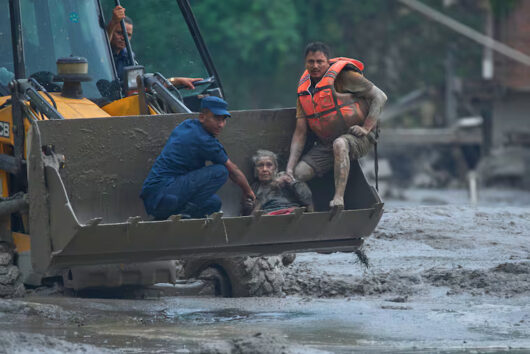
 Last week, we witnessed another stark reminder of how fragile human life can be. On August 26, 2026, a sudden collapse of glacial ice and rock in the Himalayas triggered a flash flood along the Nepal–Tibet border. Torrents of water, mud, and rock swept through pristine valleys, engulfing homes, roads, bridges, businesses, and entire towns. As of this date, 1000 people are confirmed dead and 4000 are missing, as rescue workers continue to search through lakes of debris for survivors.
Statistics, however shocking, cannot fully express what such a catastrophe means for ordinary Nepalese and Tibetan Chinese. For generations their remote mountain communities have faced difficult access to education, healthcare, roads, and economic opportunity. Now both their poverty and vulnerability are greatly amplified, while accompanied with the death of their precious neighbors and family member members.
Hurricane Katrina had a similar impact on America. When it struck the New Orleans in 2005, poor and marginalized people suffered most. In fact, when the hurricane hit the city 60,000 people were still present. Who were those 60,000? The city’s most vulnerable: those elderly, disabled, unemployed, hospitalized, and people with no financial means to escape. 1600 people also died in New Orleans. Who were those 1600? The city’s most vulnerable.
A heartening element of Hurricane Katrina was the response of compassionate people. At least 13 million Americans made financial donations to hurricane Katrina relief. 1.5 million Americans, including many of us, personally volunteered in immediate rescue, prolonged cleanup, and painstaking reconstruction.
What about in Nepal? Sundar Dhoka Saathi Sewa (“Beautiful Gate Friends Service”), is a Nepal-based, Christ-centered organization who has long served disenfranchised and disabled Nepalese people. In today’s crisis, Beautiful Gate is also on the front lines providing urgent assistance. Among them is Nepali-speaking Dr. Joe LeMaster, an INMED faculty physician who recently relocated to Nepal in long-term commitment.
How will you and I prepare for the next natural disaster? Few of us are at risk from a glacier collapse, but most of us are susceptible to a tornado, earthquake, forest fire, storm, or flood. Hazard mitigation should be a priority for every community and family unit to reduce such risks. Disaster response planning must be an additional priority for each municipality and individual.
Ultimately, such actions assert the truth that human life, though fragile, is also precious and worthy of compassion in action.