 Journeys in International Health Require Financial Steps
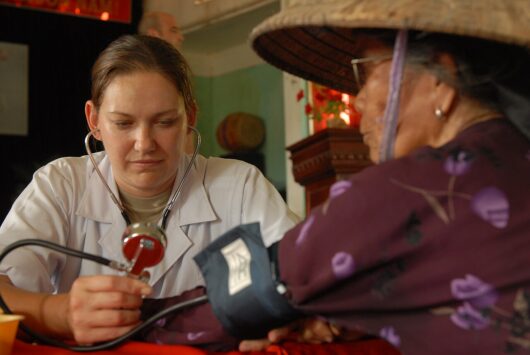
Consider the journey of Carrie Valdiviezo, who earned her Graduate Diploma in International Medicine and Public Health in 2017. As part of her INMED education, Carrie traveled to Ecuador with Indigenous Peoples Technology and Education Center (ITEC), where she conducted medical training for members of the Waorani tribe from the Amazon basin.
Carrie remembers being struck by the extraordinary journey some of her students had made simply to take part in the training.
“My new Ecuadoran friend Nanca had traveled for several days on foot through the rugged jungle terrain, even fighting off a panther before journeying the rest by canoe.”
Carrie’s experience in Ecuador stayed with her. A year later, while working as a nurse in Southwest Kansas, she volunteered as a case manager for refugee families, caring for people from the Rohingya community of Myanmar, as well as families and friends among persecuted people from Somalia and Eritrea in east Africa.
Carrie’s perspective on forgotten people grew dramatically:
“I used to think that I had to travel to the far reaches of the earth to serve certain people groups. Now, they are right in my backyard. Our new neighbors.”
Carrie summarizes her INMED experience as “a catalyst to expand my desire to serve the global health community, both at home and abroad.”
Progress along pathways in international health required important steps: compelling motivation, intellectual curiosity, personal resilience. Even with these qualities, many INMED participants cite the cost of tuition and service-learning experiences as significant barriers to opportunities like those that shaped Carrie’s journey.
This fall, we invite you to take a step with us: make a tax-deductible financial contribution to INMED.
Your gift can help make the life-changing experience of international service-learning possible for students like Carrie to work in communities alongside local health professionals, encountering divergent cultures, and discovering new dimensions of preserving health among the world’s most vulnerable.
A contribution to the INMED endowment helps build a lasting source of support for students from low-income nations. For them, tuition reduction can open otherwise impossible opportunities to in turn strengthen health care and ministry in their own communities.
You can also consider a Gift of Appreciated Assets. Donating appreciated assets, such as publicly traded securities, mutual funds, or certain real estate holdings, may provide tax advantages while supporting INMED’s mission. In many cases, donors may avoid capital gains tax on appreciated assets and receive a charitable deduction based on fair market value.
If you are age 70½ or older and own a traditional IRA, a Qualified Charitable Distribution (QCD) may allow you to support INMED directly from your IRA in a tax-efficient manner. QCDs can count toward your Required Minimum Distribution (RMD) and are generally excluded from taxable income.
The journeys of some students lead them to cross oceans and rugged terrain. Others discover that the people they once imagined serving halfway around the world are now their neighbors at home. But the destination is remarkably consistent: greater capacity to serve precious humanity.
If you value the stories and opportunities you receive from INMED, please consider making a tax-deductible gift today. Thank you for journeying with INMED and for investing in the next generation of international health leaders.